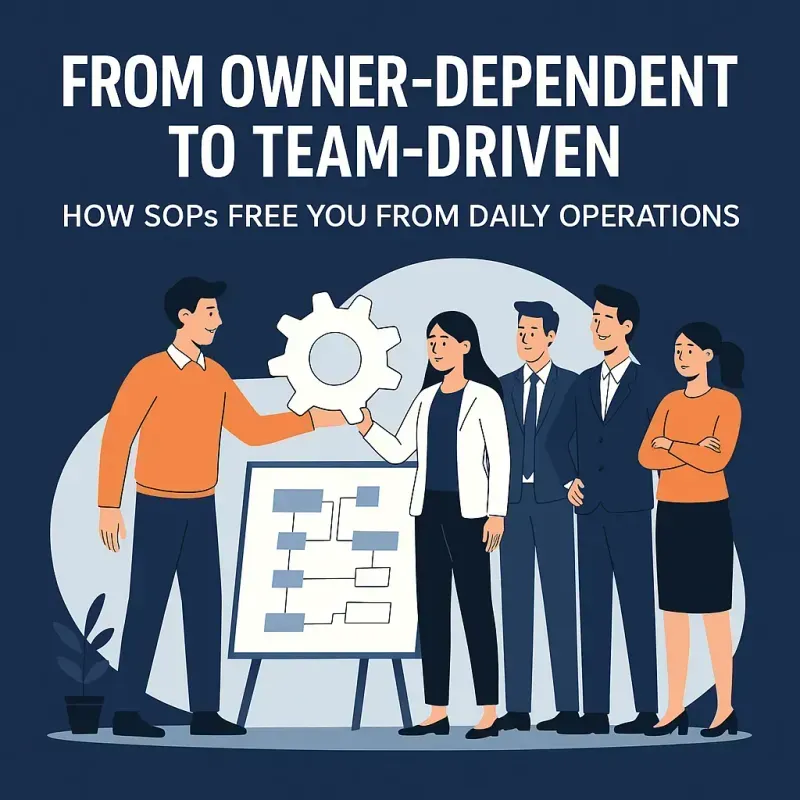
Your business should run because of the systems you’ve built — not because you’re there to babysit every detail.
Most business owners start with a dream of freedom — building something that grows, supports their lifestyle, and eventually runs without them.
But somewhere along the way, the opposite happens.
Instead of freedom, the business becomes:
dependent on the owner for every decision
full of bottlenecks only the owner can fix
a nonstop flow of questions
impossible to step away from
stressful when things get busy
reliant on the owner's memory instead of systems
This is the moment you realize:
You’re not running the business — the business is running you.
And the root cause is always the same:
There are no documented systems that allow the team to operate independently.
This article breaks down how SOPs transform an owner-dependent company into a team-driven one — and why this shift is the turning point for freedom, scalability, and long-term stability.
What an Owner-Dependent Business Looks Like
If any of these feel familiar, you're not alone:
❗ Employees ask you how to do things constantly
"How do I handle this?"
"What’s the right step?"
“Where do I find this?”
❗ You can't take a vacation without your phone blowing up
You want time off, but things fall apart when you're gone.
❗ You’re the only one who knows key processes
Invoices, estimates, approvals, customer issues, vendor communication — it all funnels through you.
❗ You hold all the knowledge in your head
Which is functional… until it isn't.
❗ Decisions pile up because people “wait for the boss”
Even small decisions get stuck in your inbox.
❗ You worry about quality unless you oversee everything
If you’re not personally watching it, you can't trust it.
This isn't a leadership issue — it’s a systems issue.
When people lack clarity, they default to dependency.
The Shift: When Documentation Replaces Dependence
Here’s the truth:
People aren’t bothering you because they want to.
They’re bothering you because they don’t have a reliable place to get answers.
Once SOPs exist and are easy to access, something amazing happens:
The business starts running on systems instead of on you.
Let’s break down what that looks like.
1. Your Team Begins Solving Problems Without You
When processes are documented:
employees stop guessing
employees stop waiting
employees start taking ownership
Instead of “What should I do?”, you start hearing:
“I followed the SOP and handled it.”
That sentence alone gives owners their life back.
2. Tasks Get Done the Same Way — No Matter Who Does Them
SOPs eliminate the “only Sarah can do that” problem.
With documented steps:
tasks don’t depend on any one person
quality stays consistent
work doesn't stall when someone’s out
delegation becomes safe instead of scary
This is operational stability — the opposite of chaos.
3. Handing Off Responsibilities Gets Easy
Most owners want to delegate, but they can’t — because the process only exists in their head.
Once it’s documented:
training takes half the time
people understand expectations clearly
managers take over without confusion
you can finally step out of the weeds
Delegation becomes plug-and-play.
4. You Finally Get the Bandwidth for Leadership, Not Micromanagement
When the team stops relying on you for daily tasks, you can focus on:
strategy
growth
hiring
partnerships
vision
improving the business instead of surviving it
This is how you reclaim your role as a true leader — not a firefighter.
5. The Business Becomes Sellable and Scalable
A business that depends on the owner isn’t a business — it’s a job.
Investors, buyers, and future leaders all look for one thing:
Documented, repeatable systems.
With SOPs:
the business can scale to multiple teams
the business can run locations the same way
the business is worth more on paper
the business isn’t tied to the owner
Your systems become an asset — not an afterthought.
6. Your Stress Drops (More Than You Expect)
Owner dependency comes with constant tension:
“Did they do it right?”
“Did they remember everything?”
“Did someone drop the ball?”
“Am I going to get dragged back in?”
SOPs eliminate that fear because the standard is documented and visible.
No more hoping.
No more micromanaging.
No more “I’ll just do it myself.”
7. Your Employees Feel Empowered
Here’s something most owners don’t see:
Employees love SOPs.
Because SOPs give them:
confidence
clarity
autonomy
the ability to excel
fewer interruptions
less stress
better performance reviews
SOPs don’t limit people —
SOPs free people.
Where SOP Manager Helps
Building a team-driven business requires systems that are easy to create, maintain, and follow.
SOP Manager supports this transformation by providing:
AI-assisted SOP creation so owners can offload documentation
organized categories for each department
centralized access so teams always know where to look
version control so processes stay accurate
searchable, mobile-friendly access for field and office teams
training tools so delegation becomes seamless
consistent formatting so every SOP looks clean and easy to follow
This makes documenting your business simple enough that it actually gets done — and powerful enough to break owner dependency for good.
The Bottom Line
If your business relies on you for everything, that’s not a personal failure — it’s a systems gap.
But the fix is straightforward:
Document your workflows.
Make them accessible.
Train your team to use them.
Refine them as the business evolves.
That’s the path from owner-dependent to team-driven.
And once you experience it, you’ll never go back.